
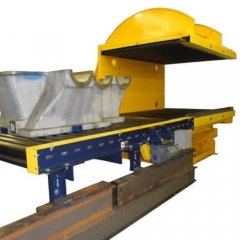
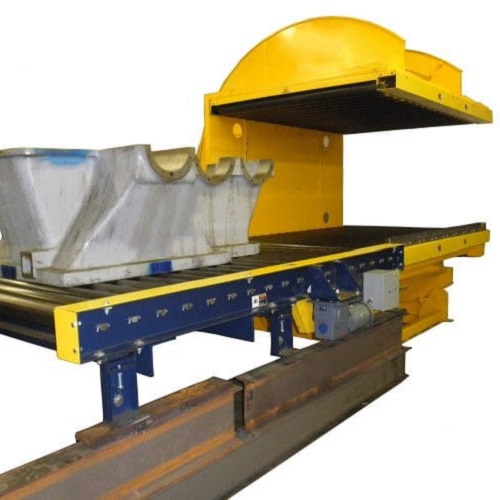
C shape pallet inverter and exchangers FZ-PC

C shape pallet inverter and exchangers for turning palletized loads and exchanging pallets underneath, turnover body 180 degree rotation by electrical motor. It's also a suitable machine for palletized paper piles.
  • Standard machine: No
  • Applicable for: Palletized load, Skid, Paper piles
  • Description
    FZ-PC series turnover machines are C shape pallet inverters and pallet exchangers designed for pallet changing and handling. Applied to all types of palletized loads, including building material, food. It's also available to turn over paper piles and exchange the pallet underneath.
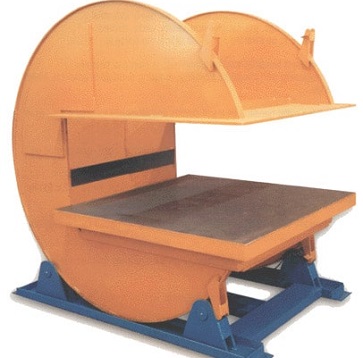
    C shape pallet turnover machine for plywood panel turnover
    Round rotation body easy to bear heavy loads and turnover with less energy costs.
    Upper clamp driven downwards to fix the pallet and goods.
    Driven by electrical motor through gear box and chain connection. 
    Available to install with pit base, easy for loading by pallet jack.
    Features
    180 degree pallet inverting, pallet exchanging by electrical mechanism rotation.
    Top press platen for clamping the pallet, keeping the goods stationary during rotation.
    Clamp can be driven by both electrical motor, hydraulic and pneumatic cylinders, depending on the loads and requirement.
    Sensor is optional to add for automatic stop of the clamping.
    Optional to add roller table for automatic in-feeding and out-feeding.
    Supportive rollers adopted for bearing the heavy load.
    Speed controlled by frequency inverters.
    Automatic stop when pallet inverting is inplace and finished.
    Smooth, accurate, vibration-free motion.
    Minimum control panel with only few buttons, clear and simple.
    Operation is simple, non-professionals are able to manage, no need for special training.
    Strong structure makes the machine very durable.
    pallet exchangers in C shape structure-min
    pallet exchangers with rotating base to benefit forklift loading and discharging-min
    pallet exchanger to turn over drums-min
    Technical Parameter
    Degree of tilting 180°
    Pallet dimension 800*800mm-1200*1200mm (customized)
    Clamping range 800-1800mm (customized)
    Max load  
    FZ-PC-01 1T
    FZ-PC-02 2T
    FZ-PC-03 3T
    Platform dimension depending on product's dimension
    Turn over speed 40-70 sec/direction
    Operation mode button control
    Power supply 380V, 3Ph, 50/60Hz( 220V, 480V.... available to customize)
    Optional Accessories
    Roller table
    for automatic pallet in-feeding and out-feeding
    Rotating base
    for convenient loading and discharging by forklift at the same side

    Key Features

    • Open C-frame — with one side of the machine open, there is no frame member in the way of the forks, so the pallet settles flat on the platform the moment it is set down.
    • Round rotation body — a ring-shaped turnover body carries heavy loads and turns them with less energy than a squared-off frame.
    • Supportive rollers — the body runs on load-bearing rollers, which keeps the turning motion smooth, accurate and vibration-free.
    • Gearbox and chain drive — an electric motor turns the body through a gearbox and chain connection, so rotation stays steady under a loaded clamp.
    • Automatic stop with settable speed — the pallet inverter machine finishes each stroke on its own when the load is back in position, and a frequency inverter lets the turning speed be set for the load.
    • Built for daily handling — the frame and the round body are made for continuous pallet work, with the moving parts carried inside the structure rather than left exposed.

    Specifications

    SpecificationDetail
    Degree of turn180° each cycle
    Pallet footprint800 × 800 mm to 1200 × 1200 mm; other sizes built on request
    Load capacity1 t, 2 t or 3 t builds (FZ-PC-01 / 02 / 03)
    Turning speed40–70 seconds per direction
    InstallationFixed floor-mounted unit

    Applications

    • Building material — bags, boxes and boards that arrive on a cracked pallet can be turned onto a sound one before they go into the rack or onto the truck.
    • Food production — move a finished food pallet onto a clean, dry pallet at the end of the line without touching the product.
    • Paper piles — a stack of sheets is turned over and re-palletised in the same cycle, which is how paper plants keep the bottom sheets clean and undamaged.
    • Plywood and panels — heavy bundles are simpler to reverse on a pallet flipping machine than to lift and turn by hand, and the stack keeps its shape while it turns.
    • Drums and round loads — drums standing on a skid or pallet are turned as one unit instead of being handled one at a time.
    • Skids and one-way pallets — a load that arrived on a throwaway skid leaves on a pooled pallet, ready for the rest of the trip.

    Options & Build Choices

    OptionWhat It Adds
    Pit base installationPuts the platform at floor level so a pallet jack can load without a forklift
    Roller tablePowered in-feed and out-feed that moves pallets into and out of the machine
    Rotating baseLets a forklift load and take the load away from the same side
    Automatic clamp stop sensorStops the clamp automatically when it meets the load
    Clamp driveElectric motor, hydraulic or pneumatic cylinders, matched to the load and the plant
    Platform sizeBuilt to suit your pallet and load footprint rather than one standard size

    Pallet Exchange Sequence

    1. Load the platform — a forklift or pallet jack brings the full pallet into the open side of this stationary pallet inverter and sets it down.
    2. Clamp the load — the top platen comes down and presses the pallet and the goods together so they travel as one block.
    3. Rotate — the turnover body swings the clamped load through 180°, which brings the pallet face up.
    4. Change the pallet — with the goods resting on the platen, the old pallet is lifted away and the replacement is set in place.
    5. Return and release — the body rotates back to the starting position, the platen lifts and the load leaves on its new pallet.

    Sizing & Ordering Notes

    Before the build starts, three numbers matter most: the weight of the heaviest load you will exchange, the footprint of the pallet or skid it travels on, and the height the stack reaches from the deck to the top. Those decide the platform size, the clamping range and which build size fits your work. It also helps to know how the load arrives at the machine — carried in on forks, rolled on with a pallet jack, or fed from a conveyor — because that shapes the platform height and the loading method. As pallet inverter manufacturers we would rather size a machine on your real numbers than on a nominal one, so send the details and we will confirm the build and the options that suit it. The same team stays with the machine afterwards for spare parts and technical help.

    FAQ

    Can it turn a load over as well as change the pallet?

    Yes. The turnover body rotates a full 180°, so the same cycle that puts a fresh pallet under a load can simply present the load the other way up. Plants that need to protect, inspect or clean the bottom face use it as a pallet flipping machine for exactly that reason. The cycle itself does not change — the only question is whether a replacement pallet goes on while the load is upside down.

    Do operators need special training to run it?

    No. The controls are deliberately simple, with a few clearly marked buttons on a compact panel, and the cycle is the same for every load, so nothing has to be reset between pallets. Most teams are confident after a single walkthrough, and the pallet inverter machine gives the same result whoever is on shift.

    What power supply does the machine need?

    The standard build runs on 380 V, 3-phase, 50/60 Hz. If your plant supplies 220 V or 480 V, that version can be built on request — as the team that builds your pallet inverter, we would rather match your supply than have you buy a separate transformer. Tell us the voltage and frequency at the installation point and the machine will be built to suit.

    How much floor space should we plan for?

    The frame footprint follows the build size and the pallet sizes you run. You also need clear room at the loading side for a forklift or pallet jack to approach and withdraw, plus headroom for the clamp to lift over the load. Because the machine is fixed, that space only has to be cleared once. Send your layout and the pallet sizes and we will confirm the clearance your unit needs.

    What maintenance does the machine need?

    Day-to-day care is mostly cleanliness: keep the platform, the rollers and the clamp face free of grit and product debris, and keep the load area clear. The drive chain, the clamp mechanism and the panel are checked at the intervals set out in the manual. This is a stationary pallet inverter, so nothing has to be repositioned between shifts — the working parts run inside the frame.

    Are there loads that are not right for this machine?

    Anything that can take a firm press from above is normally fine. Loads with very fragile tops, loose sacks that would slump when inverted, or stacks whose height varies a lot from pallet to pallet are worth talking through before you order. As pallet inverter manufacturers we would rather point out a poor fit now than have you find out on the shop floor.